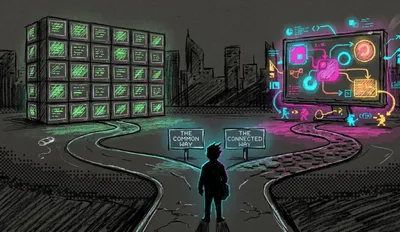
Hero image by Jayse Hansen
Somewhere around 2008 I cold emailed a guy in the UK whose showreel I had been replaying on loop for weeks. Every frame looked like it had fallen out of a film I had not seen yet. Translucent grids. Pulsing data feeds. Screens that felt alive. I wanted to know how someone builds interfaces that do not exist for software that was never written.
Mark Coleran replied the same day. Generous does not cover it. He gave me a full interview, answered every question like it mattered, and then kept the conversation going for years after. Skype calls where I would pick his brains on whatever interface problem I was stuck on. Messages where he would tip me off to some obscure talk or paper. One time he pinged me because a quote from our interview had surfaced in a UX video at the 9:53 mark. “The UX kids are watching,” he wrote. Turned out the line traced back to something Bill Moggridge had said, which Mark had challenged in a Q&A, which I had published, which someone else had quoted on camera. Ideas bouncing off walls he had built years earlier.
He was also genuinely funny. He once convinced me to trash talk Starship Troopers 3 on Twitter just to see if Casper Van Dien would come after us. He did. Mark thought it was the funniest thing that had happened all week. Another time, job hunting in Canada and facing visa deadlines, he described himself as “HR’s best dream and worst nightmare. I give them a reason to exist and a lot of work.” Then added: “Hence fired previous.” The man could land a punchline in a DM the same way he could land a data feed animation on a 40 foot cinema screen.
I never published that interview at the time. Sat on it for 2 years like an idiot. By the time I finally put it out in January 2010, the world had already started catching up to what Mark had been designing on screen since the late 1990s.
He died on June 14 2024 in Sweden, where he had been working on a project for Volvo. He was 54.
The Term Nobody Else Coined
As far as I am concerned, Mark Coleran coined the phrase Faux User Interface. FUI. Others may dispute the origin. I do not care. Before him, the discipline had no name. People who built screen graphics for film were just motion designers who happened to work on set. Coleran gave the craft an identity, and in doing so he turned scattered freelance work into a recognized field with its own language, its own constraints, its own masters.
His credits read like a highlight reel of early 2000s action cinema. Tomb Raider. Spy Game. The Bourne Identity. Blade II. Alien vs Predator. The Island. Mr. and Mrs. Smith. Mission: Impossible III. Children of Men. The Bourne Ultimatum. Each film required interfaces that looked real enough to believe but cinematic enough to tell a story in a single glance.
The fundamental problem of sci-fi interfaces is they’re not interfaces. They’re there to illustrate, or demonstrate something happening.// Mark Coleran
That distinction mattered. Mark once told me you have 30 seconds to convince a viewer of some complex action or plot point. 30 seconds. That is not a lot of time to cram a dense narrative beat into the heads of an audience spanning every age and technical literacy. In software we have the luxury of progressive disclosure, onboarding flows, tooltips. In film you get half a minute and you cannot skip a beat.
That conversation rewired how I watch movies. I stopped laughing at ridiculous hacking scenes after that. The scrolling green text, the absurd progress bars, the 3D file systems. None of it is trying to be real. All of it is trying to make you understand in 30 seconds that the character just broke through a firewall. Did you get that the actor was hacking? Yes? Then the FUI did its job. Accuracy was never the point. Clarity at speed was the point. Coleran understood this tension better than anyone working at the time, and his solutions were so convincing that the tech industry kept mistaking his fiction for a roadmap.
Fiction That Became Furniture
For Children of Men in 2006, Coleran designed a music player for the character Jasper. It featured an album art browser that scrolled through covers in a fluid, dimensional ribbon. Apple released CoverFlow later that same year. Coleran did not invent the concept (Apple acquired it from an independent developer), but he had researched emerging interaction patterns and extrapolated them into a finished visual months before the real product shipped. That was his method. Look at what the labs and the hobbyists are building in basements, then make it look finished on a cinema screen 3 years before it hits the shelves.
The table interface in The Island landed in 2005.
Sean Bean sat over a flat surface and manipulated data with his hands. Microsoft Surface arrived 2 years later. Sean Bean sat over a flat surface and manipulated data with his hands. Microsoft Surface arrived 2 years later. Multi-touch tables were already in development at MIT and elsewhere, but most audiences saw Coleran’s version first. When I asked him about it, he pushed back on the idea that any of it was prophetic.
There is never anything particularly prescient about most of this faux technology. It is all out there, but just not widespread. I look at what labs and hobbyists are doing in basements. We get to make it up and make it look real a few years before it hits the shops.// Mark Coleran, from our 2008 interview
That humility was characteristic. He never claimed to predict the future. He just paid closer attention to the present than most designers bothered to.
The DVD That Built Hollywood
There was a running joke among FUI artists that Mark loved to tell. A single DVD of graphical elements circulated between productions. Hexagonal grids. Wireframe globes. Scrolling data columns. Animated waveforms. Every FUI artist in the business had a copy, and pieces of it showed up in film after film, passed hand to hand like a secret recipe. The same spinning globe might appear in a Bond villain’s lair one year and a CIA war room the next.
It sounds absurd until you consider the economics. FUI work on a film might span 6 weeks. The budget is a fraction of what visual effects receive. You build fast or you do not build at all. That DVD was survival kit and inside joke rolled into one, a shared toolkit for a discipline so small that everyone in it knew everyone else by first name.
Most FUI is not functional software. It is animation played back at the correct moment during filming, or composited in post production. The tools are After Effects, Illustrator, Cinema 4D. The audience sees an interface. The actor sees a green dot and a timing cue. Coleran once noted that the moment an actor starts actually using an interface, they stop performing. The illusion works precisely because it is an illusion.
The Interview I Sat On
In January 2008 I sent Mark a set of 10 questions about his process, his philosophy, and where he thought UI was headed. His answers were sharp enough that I am going to reproduce several of them here, because they have aged better than most design manifestos written since.
On whether his work was truly bleeding edge:
I am not sure it is as bleeding edge as it may at first appear. By the nature of most of the films and the requirements of the interfaces in those films, we do make them look a lot better than they might look if they were a real device. It is a visual medium and your primary task is to tell a small part of the story, sometimes very quickly.// Mark Coleran, 2008
On where UX should head next:
UX should become as divorced from engineering as possible. Not in the sense of not working with engineering, but that solutions should not be defined by engineering parameters. It should also become divorced from the systems that it runs on. Why should people learn a system rather than simplify a task they want to do?// Mark Coleran, 2008
On metaphors in software design:
A metaphor nearly always feels forced. A real world equivalence that does not always work. There have been great examples of their use in the past but they seem to be regularly over used these days. Stretched almost to breaking.// Mark Coleran, 2008
On what he would tell every designer in the world:
Users will rarely ever be designers, but designers always have to be the users. Without an intuitive grasp of the problem you are trying to solve, it will always be a best guess no matter how much you listen to the end user.// Mark Coleran, 2008
Read that last one again. It was 2008. The design industry spent the next 15 years arriving at the same conclusion through a thousand blog posts, conference talks, and methodological wars. Mark said it in 2 sentences and moved on.
What He Would Have Made of AI
This is the part I keep circling. Mark left film in 2007 and spent the rest of his career working on real software, first at Gridiron Software in Canada, then freelancing for Samsung, Sony, and LeEco, then at Volvo. He had already crossed the line from fiction to production. He knew what survived the translation and what did not.
His philosophy was what he called pragmatic futurism. Ground the fantasy in research. Make it feel like its feet are still on the ground. He hated unnecessary decoration, complexity for its own sake, and interfaces that blamed the user for the designer’s failures. Alfonso Cuaron called him the Design Taliban on Children of Men because his standards were that exacting.
So how would he have approached generative AI as a design tool? I think the answer lives in something he said about the invisible interface.
The tool should be almost invisible in relation to the thing that people are trying to achieve. Simplicity and transparency. Focusing on the task at hand and nothing else is the key.// Mark Coleran, 2008
He would have used AI where it disappears into the task. Rapid iteration of screen comps. Filling a grid with 40 variations of a data visualization so the director can point at the one that tells the story fastest. Generating texture and motion at a speed that matches the brutal timelines FUI artists work under. The parts of AI that serve the craft without replacing the eye, those he would have grabbed with both hands.
The parts that generate a finished interface from a prompt and call it design? He would have burned them on sight. Mark understood something that most AI evangelists still have not figured out: the value of an FUI screen is not in the pixels. It is in the decision about which pixels serve the story. A model that produces output without understanding the narrative constraint is doing decoration, not design. He said as much about real software 18 years ago. The principle scales.
Ask whether the tool makes the designer’s judgment faster or whether it replaces the designer’s judgment entirely. Mark would have embraced the first and walked away from the second. The task is everything. The tool is invisible. If the tool becomes the experience, you have failed.
What He Left Behind
Mark Coleran did not just build interfaces for movies. He built the conceptual vocabulary for an entire discipline. He gave it a name. He gave it rigour. He gave it the insistence that fiction grounded in research is more useful than speculation untethered from reality. Every transparent HUD in every Marvel film, every holographic war room in every streaming thriller, every real product designer who has ever pinned a film screenshot to a mood board and said “like this but real” is working downstream of decisions Mark made in a dark edit suite at Pinewood 25 years ago.
In July 2023, less than a year before he died, I tagged Mark on Twitter crediting him as the spark behind my FUI obsession. His reply was perfectly him.
Hey! I am blameless. Take responsibility for your own rabbit holes ;) But that is nicely done.
— Mark Coleran (@Coleran) July 26, 2023
Blameless. The man who sent an entire generation of designers down the FUI rabbit hole, waving them off with a grin. That was the last public exchange I can find. A year later he was gone.
The debt keeps getting paid forward though. The team at Rive have been quoting and referencing Mark’s work for years, and their product is now shaping the next generation of FUI. Guido Rosso, one of Rive’s co-founders, ran a thread in January 2023 showcasing the best motion UI work he could find.
He worked through instrument clusters, targeting systems, vehicle dashboards, Halo visor bootups. Then came the inevitable acknowledgment.Obviously can’t have a thread like this without @Coleran pic.twitter.com/PI684HRLdW
— Guido Rosso (@guidorosso) January 12, 2023
Obviously can’t have a thread like this without @Coleran.// Guido Rosso, Rive co-founder
Obviously. The thread traces a direct line from Mark’s cinema screens in the early 2000s through to the interactive FUI being built in Rive today. Different tools. Same bloodline.
His original website at markcoleran.com is gone, swallowed by domain squatters. Kirill Grouchnikov at Pushing Pixels has lovingly reconstructed a gallery of his work, and it is worth the visit. The showreel still holds up. The interfaces still look like they belong to a future we have not quite reached.
I owe him more than a blog post. His work is the reason I fell headfirst into FUI as a fascination, then a hobby, then a lens through which I judge every interface I encounter. He was the godfather of the discipline. Whether he invented the category or simply defined it so completely that the distinction stopped mattering is a question I never got to settle with him over a drink.
What I do know is that the next generation of screen designers, the ones using AI to generate FUI at speeds Mark could not have imagined, should know his name. They should study his reels. They should read his interviews and understand that every beautiful screen in a film exists to serve a story, not to impress a viewer. Get that wrong and you are just making wallpaper.
Mark got it right every single time. I am still angry he is not here to get his hands on the new toys. The generative tools, the real time renderers, the AI compositing pipelines. He would have torn through them and made something none of us had thought to ask for yet. That is the part that stings. Not just losing the man but losing what he would have built next.
When people tell me AI will replace designers, I think of Mark and dismiss it outright. You can copy what he did. You can feed his reels into a model and get something that resembles the output. But you will never beat him at that game. The decisions behind those pixels, the instinct for which frame serves the story, the 30 second constraint internalized so deeply it became reflex: no model owns that. No model will.
Mark, you were a friend. You gave me your time and expected nothing in return other than a shared laugh. You inspired me to always be a better designer, and even now when I sit down to design a UI, I think of your work and your advice.
// SENSOR_DATA_OVERLAY: FIELD_INTENSITY 0.92Hz
// "The design isn't just a shell; it's a sensory interface for the model's weights."